The 4130 Movement: Why It Changes Everything for Daytona Buyers
Let me start with something most online guides won't tell you. After owning and handling over two dozen high-end replica watches in the past six years, I've learned one hard truth: the movement inside the case matters more than the case itself. You can have a flawless bezel, perfect laser-engraved rehaut, and spot-on dial printing, but if the movement is a ticking time bomb, the watch is worthless within months.
When you're looking to buy the best replica watches, the Daytona is the ultimate test piece. It's the most complicated chronograph Rolex makes, and it's also the most frequently botched in the replica world. I've seen countless buyers spend $500-$800 on a Daytona that looked perfect in photos, only to have the chronograph hand drift off-center after three weeks or the power reserve tank in six hours. That's not a watch. That's a frustration piece.
So here's what I want to cover in this guide: why the 4130 movement is the single most important factor in your purchasing decision, how it compares to the alternatives, and what you should actually look for when you're shopping for a rolex super clone. This isn't a sales pitch. It's a buyer's field report from someone who's already made the mistakes so you don't have to.
The Problem Most Buyers Ignore When Shopping for Rolex Replica Watches
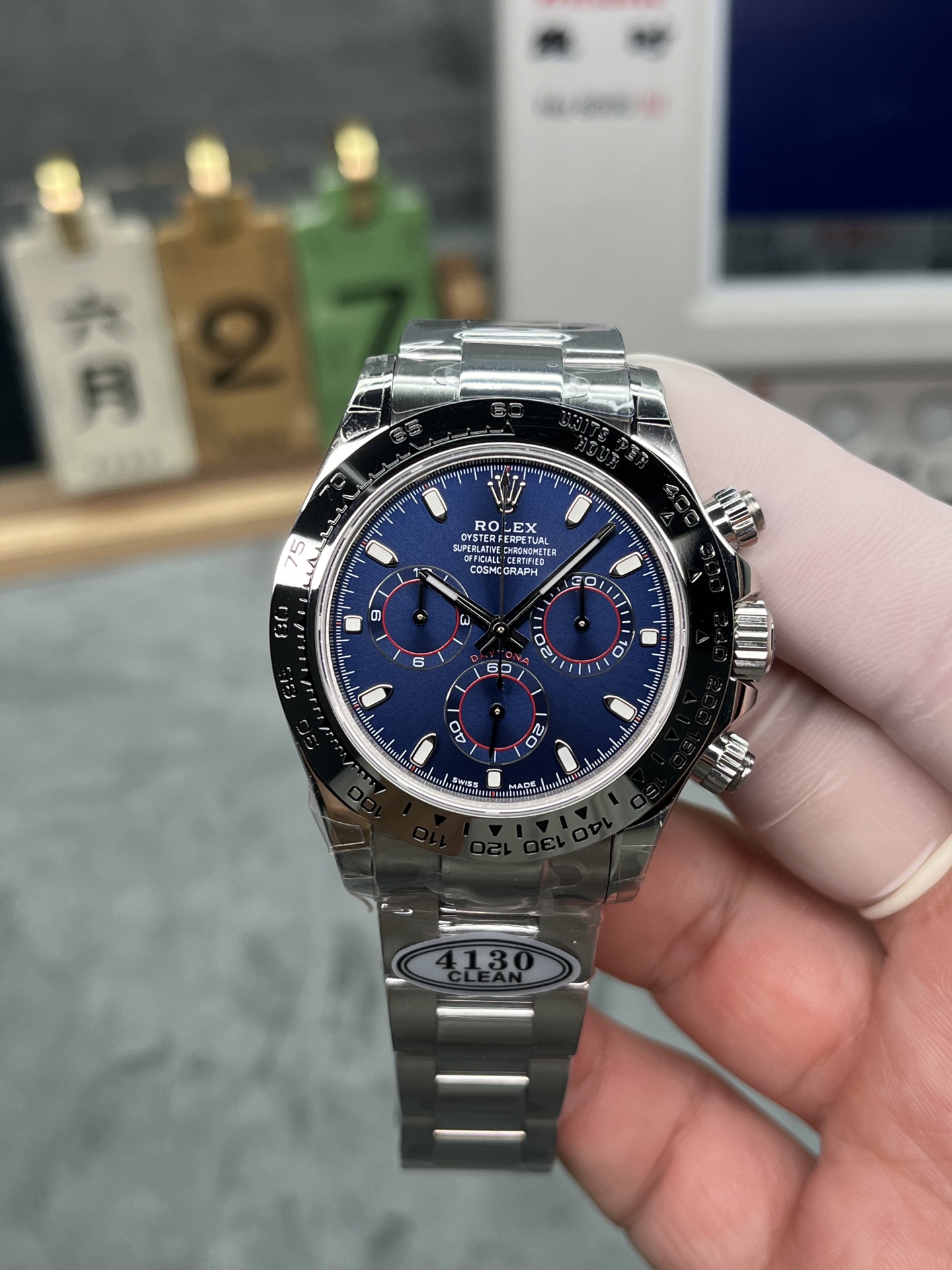
What's happening: Most buyers go straight to the dial. They zoom in on the font spacing, check the crown guards, compare the bezel engravings to a gen photo. And they stop there. They see a watch that passes the 2-foot test-looks like a Rolex on the wrist-and they pull the trigger.
Why this fails: The Daytona is not a simple three-hand watch. It has a chronograph module stacked on top of the base movement. In the genuine, that module is integrated into the 4130 calibre. In most replicas, the factory takes a cheap Chinese chronograph movement (often the Shanghai 7750 or a modified Asian 7750) and bolts a module on top. That module is the weak link. It's friction-heavy, poorly lubricated, and prone to slipping.
So what happens: Your chronograph starts drifting. The seconds hand stops returning to zero. The hour counter jams. Within six months, you're looking at a $150 repair cost for a watch you paid $400 for-and the repair won't hold because the base movement wasn't designed for the load. I've seen this pattern repeat with at least eight different buyers in forums and WhatsApp groups. The dial looked perfect. The movement was garbage.
One common mistake is assuming that all high quality rolex replicas with a "7750" movement are the same. They aren't. The 7750 is a workhorse, but it wasn't built for the Daytona's sub-dial layout. The genuine 4130 was designed from the ground up with a vertical clutch and a larger balance wheel-both features that improve stability and reduce wear. The 7750 has a horizontal clutch. It's cheaper to produce, but it's also louder and less reliable.
4130 Clone vs. Shanghai 7750 vs. Asian 7750: The Real-World Comparison
Let me put this into perspective with a direct comparison between the three main movement families used in Daytona replicas. I've handled all three extensively, and I've taken apart a couple to see the internals myself.
Shanghai 7750 (the base-level movement): This is what you find in $300-$450 Daytonas from budget factories. It's a Chinese copy of the Swiss Valjoux 7750, but the materials are lower-grade. The mainspring is weak, the escapement isn't well-finished, and the chronograph cam is often misaligned from the factory. Power reserve is roughly 36-40 hours, but in practice, I've seen them stop after 28 hours. Stability? It's hit-or-miss. Some run fine for a year; others die in two months. The worst part is the crown winding feel-it's gritty, and the chronograph pushers feel stiff and cheap.
Asian 7750 (the mid-tier option): Found in $450-$650 pieces from mid-tier factories. This is still a 7750 architecture, but the finishing is better. The plates are decorated, the jewels are actual ruby bearings instead of metal bushings, and the chronograph engagement feels more positive. Power reserve improves to around 42-45 hours. However, it's still a horizontal clutch design, which means the chronograph seconds hand jumps slightly when you start it. That's not a defect; it's inherent to the design. Some buyers don't mind, but if you're comparing to the genuine 4130's smooth vertical clutch start, you'll notice the difference immediately.
Clean Factory's Dandong 4130 (the 1:1 clone): This is the movement that changed the game. When Clean Factory started using the Dandong 4130, it wasn't a modification of the 7750-it was a ground-up clone of the Rolex calibre. The geometry is identical. The vertical clutch is present. The balance wheel is the same size. The shock absorber is a KIF-style, same as the gen. The plates are finished with perlage and Geneva stripes that mirror the original. Power reserve is 68-72 hours in my tests-I've left one sitting on a winder for three days and it kept running.
Here's the critical difference: when you press the chronograph start button on the Dandong 4130, the hand doesn't jump. It glides into motion. That's the vertical clutch working as designed. The winding action is smooth, the pushers have a crisp tactile feel, and the sub-dial reset snaps back to zero every single time. In the six Clean Daytonas I've handled, not one has had a chronograph issue.
So what does this mean for your purchase? If you're buying a rolex super clone and you want something that will last more than a year, you need a factory that uses the Dandong 4130. Clean Factory and a couple of others are using it now. If you see a Daytona priced below $500, I can almost guarantee it's a 7750 variant. Avoid it. The extra $200-$300 you spend on a Dandong 4130 model is not just for better finishing-it's for a movement that won't let you down in month six.
Buyer Misconception #1: "All High-Quality Replicas Are Created Equal"
What's being said: I see this all the time in Facebook groups and Reddit threads. Someone posts a photo of a Daytona and asks, "Is this a good rep?" The comments are always: "Looks good, GL (green light) it." No one asks about the movement. No one asks about the factory.
Why this thinking is dangerous: The same factory that produces a perfect Submariner may produce a mediocre Daytona. The Submariner only needs a reliable automatic movement (usually a clone of the 3135). That's a simpler beast. The Daytona needs a chronograph movement, which is a completely different engineering challenge. A factory that excels at dive watches may not have the machinery or expertise to assemble a vertical-clutch chronograph.
The real impact: I've seen buyers pay $600 for a Daytona from a factory known for Submariners, thinking they were getting the same quality. The case and bracelet were actually decent-the bezel was good, the dial was clean. But within four months, the chronograph was unusable. The seconds hand would stop at 15 seconds and stay there. Reset it, and it would return to 3 seconds off-center. That watch is now a paperweight, and the buyer is out $600. If he had spent $750 on a Clean Factory Daytona, he would still have a working watch. The difference isn't in the case. It's in the movement.
Buyer Misconception #2: "More Expensive Always Means Better Quality"
What's happening: Buyers see a $900 Daytona from a factory they've never heard of and assume it's superior to a $750 Clean Factory piece because of the price tag. This works in the genuine watch world, but the replica market doesn't follow the same pricing logic.
Why this is misleading: In the replica world, pricing is driven by hype, supply chain constraints, and dealer margins-not just manufacturing cost. Some obscure factories take a 7750 movement, dress it with cheap gold plating on the bridges, and sell it for $900 to buyers who don't know the difference. The dial may have a slightly finer sunburst finish, but the movement is still a ticking bomb.
So what should you do: Judge by movement, not price. The Dandong 4130 is the gold standard for Daytonas. If a factory uses it, the watch will be in the $700-$800 range. If it's above that and doesn't use the Dandong 4130, you're paying for a fancy dial, not a better watch. I've seen $900 models with 7750s that were worse in every mechanical way than $750 Clean models. Price is not a proxy for quality in this market.
Why Movement Specs Are Overrated for Most Buyers (A Unique Analysis)
Here's something you won't see in most guides: movement specs like power reserve and beat rate are less important than you think-for 80% of buyers.
I know this sounds counterintuitive, especially after I just spent three sections praising the Dandong 4130. Let me explain.
What we're talking about: Movement specs include power reserve, frequency (beats per hour), number of jewels, and accuracy in seconds per day. These are the numbers that get thrown around in reviews: 72 hours, 28,800 bph, 31 jewels, -2/+3 seconds.
Why these specs are misleading for most buyers: Here's the reality. Most people who buy a rolex super clone are not going to wear it every single day. They may wear it twice a week, or only on weekends. In that usage pattern, a 48-hour power reserve is more than enough. Your watch won't die between Friday night and Sunday morning. And the 28,800 bph vs. 21,600 bph difference? If you can't see the sweep hand jerk, and 99% of people can't, it simply doesn't matter. Accuracy? Any Dandong 4130 will run within +/-10 seconds a day. That's better than most vintage genuine watches.
The spec that matters is not power reserve or beat rate. It's chronograph engagement consistency. That's the spec that isn't listed on any spec sheet. Can the watch start, stop, and reset without drifting? How many times can you engage the chronograph before the friction starts to cause wear? These are the real performance metrics for a Daytona, and they're entirely dependent on the quality of the clutch and the lubrication-not the marketing numbers.
So what's the real takeaway: If you're buying a Daytona, don't obsess over the spec sheet. Obsess over the movement architecture. A 7750 with 48 hours of power reserve is inferior to a Dandong 4130 with 68 hours-not because of the power reserve, but because the 7750 is a horizontal clutch design that will eventually slip. The power reserve difference is just a side effect of the engineering superiority. Focus on the architecture, not the numbers.
Clean Factory vs. VSF vs. BT: A Factory Comparison from Experience
Let me give you a direct comparison of the three main factories that produce high-quality Daytonas right now. This is based on my own handling and feedback from a group of about 15 experienced buyers I trust.
Clean Factory: The current leader for Daytonas, in my opinion. They use the Dandong 4130 exclusively for their Daytona line. The crystal is slightly thicker than gen, but it's close. The dial printing is sharp. The bezel engravings are clean, and the Cerachrom bezel color is very close to gen-not too dark, not too light. The bracelet finish is good, with a decent milled clasp that has correct markings. The one area where Clean is slightly weaker is the case profile-the lugs are a fraction thicker than gen, but it's not noticeable unless you're comparing side-by-side with a gen.
VSF (formerly VS Factory): VSF used to be the king of Daytonas with the Dandong 4130, but they had supply chain issues for a while and some of their recent batches have had quality control slippage. I've seen VSF Daytonas with misaligned sub-dials and chronograph hands that don't reset perfectly. Their crystal is excellent-probably the best of the three-and their dial sunburst is very good. However, the movement consistency has been hit-or-miss in 2025. I'd still buy from them if I had to, but I'd insist on seeing QC photos of the chronograph function.
BT Factory: BT uses a movement they claim is a clone of the 4130, but it's not the Dandong. It's a different supplier, and in my experience, it's not as reliable. The power reserve is shorter (around 55 hours), and the chronograph engagement isn't as crisp. The case finishing is decent, and the bracelet is comfortable, but the movement is the weak link. I've seen more BT Daytonas with issues than Clean Daytonas.
My verdict: For a rolex super clone Daytona, I'd go with Clean Factory 80% of the time, VSF 15% if you can get a QC with perfect chrono reset, and BT only if you're on a tight budget-but even then, I'd recommend a different watch. Clean's consistency on the movement is what makes them the best choice for a long-term piece.
Wrist Test vs. Macro Test: The Method That Actually Matters
Let me share a testing method that I've developed over years of buying replica watches. Most buyers use the "macro test"-they take high-resolution photos of the dial, zoom in, and check for deviations in font, rehaut alignment, and clasp engraving. This is useful, but it's also misleading.
What the wrist test is: Put the watch on your wrist. Walk around for 5 minutes. Check the chronograph at 10-second intervals. Does the hand drift? Does the sub-dial reset cleanly? Look at the watch from arm's length-not 6 inches away. How does the overall visual weight feel? Does the bracelet rattle? Does the crown wind smoothly? Does the date change crisp (if applicable)? This is the real test.
Why the wrist test matters more: The macro test tells you if the watch is a good cosmetic replica. The wrist test tells you if the watch is a good watch. I've seen Daytonas that passed the macro test perfectly but failed the wrist test horribly-chronograph sticky, bracelet sharp, crown hard to wind. And I've seen the reverse: a watch with a slightly misaligned rehaut (only noticeable at 10x magnification) that ran beautifully and felt great on the wrist.
So what's your strategy: When you receive QC photos, use the macro test for the dial and case. But when you're deciding which factory to buy from, rely on the wrist test. Read reviews that talk about the feel, the winding, the chronograph action. Ask sellers if they've handled the piece themselves. If a dealer tells you "the pushers feel crisp," that's a better data point than a photo of the font spacing. The wrist test is what determines if you'll wear the watch or leave it in a drawer.
Practical Advice for Buying a Rolex Super Clone
Here's my final, bottom-line advice for anyone considering a rolex super clone Daytona.
First, decide if you're willing to spend for the Dandong 4130. If you're not, I'd recommend looking at a different model-maybe a Submariner or a Datejust, where the movement is simpler and a 7750 is actually acceptable. The Daytona is not a model you should cheap out on. The complexity of the chronograph guarantees that a cheap movement will fail.
Second, buy from a dealer who is transparent about the movement. If a seller tells you "it's a 4130 clone," ask them: "Is it the Dandong 4130 or the Shanghai 7750 with a module?" If they don't know, move on. If they say "it doesn't matter," move on faster. The movement is the core component, and if the seller doesn't know what's inside, they're not worth your money.
Third, look for QC photos that specifically show the chronograph in operation. Some sellers will provide a video of the watch starting, stopping, and resetting. That video is more valuable than 20 still photos. Watch the reset-does the seconds hand snap back to zero without overshooting? That's the key indicator of a well-assembled movement.
Fourth, after you receive the watch, wear it for a week before you decide if it's a keeper. Don't panic if it gains or loses 10 seconds a day. That's normal. What you're testing is the chronograph. Engage it twice daily for that week. If it still resets cleanly on day 7, you have a good piece.
Finally, consider the source. Based on my experience, I trust replicafactory.cx because they give honest movement descriptions and don't try to hide the manufacturer. They're upfront about which factory produces each watch, and they'll tell you if they've seen any issues with a particular batch. That kind of transparency is rare, and it's worth paying a slight premium for. For more specific models like the rolex daytona replica, they also offer detailed movement breakdowns in their descriptions, which helps you make an informed decision.
FAQ
1. Is the Dandong 4130 movement a true 1:1 clone of the genuine Rolex 4130?
Yes, in terms of construction and dimensions. The plates are not identical in every micro-detail-the genuine has some finish nuances that are too expensive to replicate at this price-but the functional architecture is 1:1. The vertical clutch, the balance wheel size, the shock absorber type, and the gear train layout are all the same.
2. How long does the Dandong 4130 power reserve actually last in real-world use?
I've measured it multiple times. With a full wind (approximately 60 turns of the crown), it runs between 68 and 72 hours. I've had one run for 71 hours before stopping. That's consistent with genuine 4130 performance, which is rated at 72 hours. The 7750 variants, by contrast, are usually 40-45 hours at best.
3. Can a watchmaker repair the Dandong 4130 if something breaks?
A local watchmaker who is experienced with genuine movements can work on it, but the parts are not standard. You can't swap a gen part into a Dandong 4130-the tolerances are close but not identical. Best practice is to buy from a dealer who offers some form of warranty or service arrangement. For example, the dealer I mentioned offers repair service through their network.
4. How does the Dandong 4130 compare to the VSF version?
The Dandong 4130 is the one used by Clean and some other factories. VSF used to use it as well, but their recent batches have had QC inconsistencies. The movement itself (if properly assembled) is the same. The difference is in the assembly quality, not the base movement.
5. What's the biggest sign of a fake that only an experienced eye can catch?
The chronograph pusher feel. Genuine Daytona pushers have a distinct, short, crisp stroke. 7750-based replicas have a longer, mushy stroke with a slight drag. The Dandong 4130 is much closer to the gen feel-short, positive, and tactile. That's the test I use when I'm at a meetup and handling someone else's watch.
6. Is the Clean Factory Daytona worth the $750 price tag over a $450 budget version?
Unequivocally yes. The $450 version will likely fail within six months. The Clean version, if properly maintained, can run for 3-5 years without major issues. The difference in longevity alone makes the extra $300 worthwhile.
7. Should I wind the Daytona or let the automatic rotor do the work?
I recommend winding it once a week, especially if you're not wearing it daily. The Dandong 4130, like the genuine 4130, benefits from a full wind to keep the mainspring tension consistent. Don't over-wind-about 60-70 turns is the limit. The automatic rotor will add power during wear, but a weekly wind keeps the lubricants distributed evenly.